

Let us explain... When developing and operating AI applications, AI Agents and AI wokflows, developers and AI companies often face security threats, including hallucinations, compliance risks, data breach risks, prompt injection attacks, and jailbreaking. These AI risks not only threaten normal business operations but also bring significant compliance and social risks to enterprises.
AI Sentinel allows you to implement effective protection mechanisms based on your policies, regulations, and business needs. It covers various threat scenarios, including content compliance, sensitive data, prompt attacks, malicious files, malicious URLs, model hallucinations, and prompt crawlers. The service also supports embedding digital watermarks into generated content.
AI Sentinel ensures the compliance, security, and stability of AI-powered initiatives by providing a comprehensive protection system for pre-trained LLMs, AI services, and AI Agents. Particularly in generative AI input and output scenarios, AI Sentinel provides accurate risk detection and proactive defense capabilities.
Protect Data PrivacyData leak prevention through data encryption and masking: AI Sentinel thoroughly detects privacy data and sensitive information that may be exposed during AI interactions. It supports the identification of personal and corporate-sensitive content to prevent risks such as training data leakage and conversation information spillage. It is applicable to scenarios such as AI in healthcare, financial services, and enterprise knowledge base Q&A systems.
Privacy concerns due to possible interaction data loss
Three-layer protection architecture Content Moderation - Dynamic Defense - Model Health. By leveraging multimodal detection, threat intelligence analysis, and an intelligent policy engine, it provides comprehensive coverage for content compliance, attack defense, and AI internal risk governance. This ensures security and compliance for AI applications, enabling them to operate stably, reliably, and efficiently in complex environments. Together, we build responsible and secure AI.
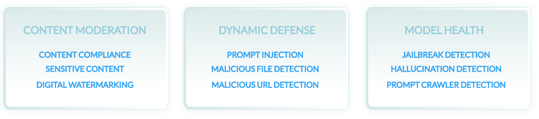
AI Sentinel 3-layered architecture diagram
Support ComplianceCompliance with regulatory requirements: Multi-dimensional compliance checks are performed on the input and output text of generative AI, covering risk categories such as politically sensitive content, pornography, bias, discrimination, and harmful values. This enhances the reliablity that your AI-generated content aligns with laws, regulations, and platform policies. It is applicable to scenarios like chatbots, AI education, intelligent customer service, and AIGC (Artificial Intelligence Generated Content) content creation platforms.
The following compliance requirements are met using Sentinel (Partial list)
Strengthen Business SecurityReal-time threat detection and response: Comprehensively defends against injection attacks targeting generative AI by accurately identifying adversarial behaviors such as jailbreak prompts, role-play inducements, and system command tampering. This builds an "immune defense" for AI systems. It is applicable to scenarios like secure instruction interaction with AI Agents, defending open-domain dialogue systems from adversarial attacks, and access control for third-party plug-in calls.
System instability and business risks due to prompt injection attacks
Improve Business AdaptabilityMulti-layer protection system: Supports customizable risk detection settings. In the AI Sentinel console, you can enable or disable specific risk checks to create the most suitable risk detection template based on your business requirements.
Achieve Flexible Integration and Cost ReductionAI Sentinel supports API integration and one-click activation to meet fast deployment needs. It offers pay-per-call or token-based billing models, allowing flexible cost control while ensuring efficiency and cost-effectiveness.
Support Large-scale Business ScenariosHigh-concurrency capability ensures your system remains stable even during traffic surges, preventing service interruptions caused by overload. The system can quickly respond to each request, enabling real-time detection and processing of user-submitted content and reducing latency.